
Milkfed Episode 1: Context
Listen or read the transcript.

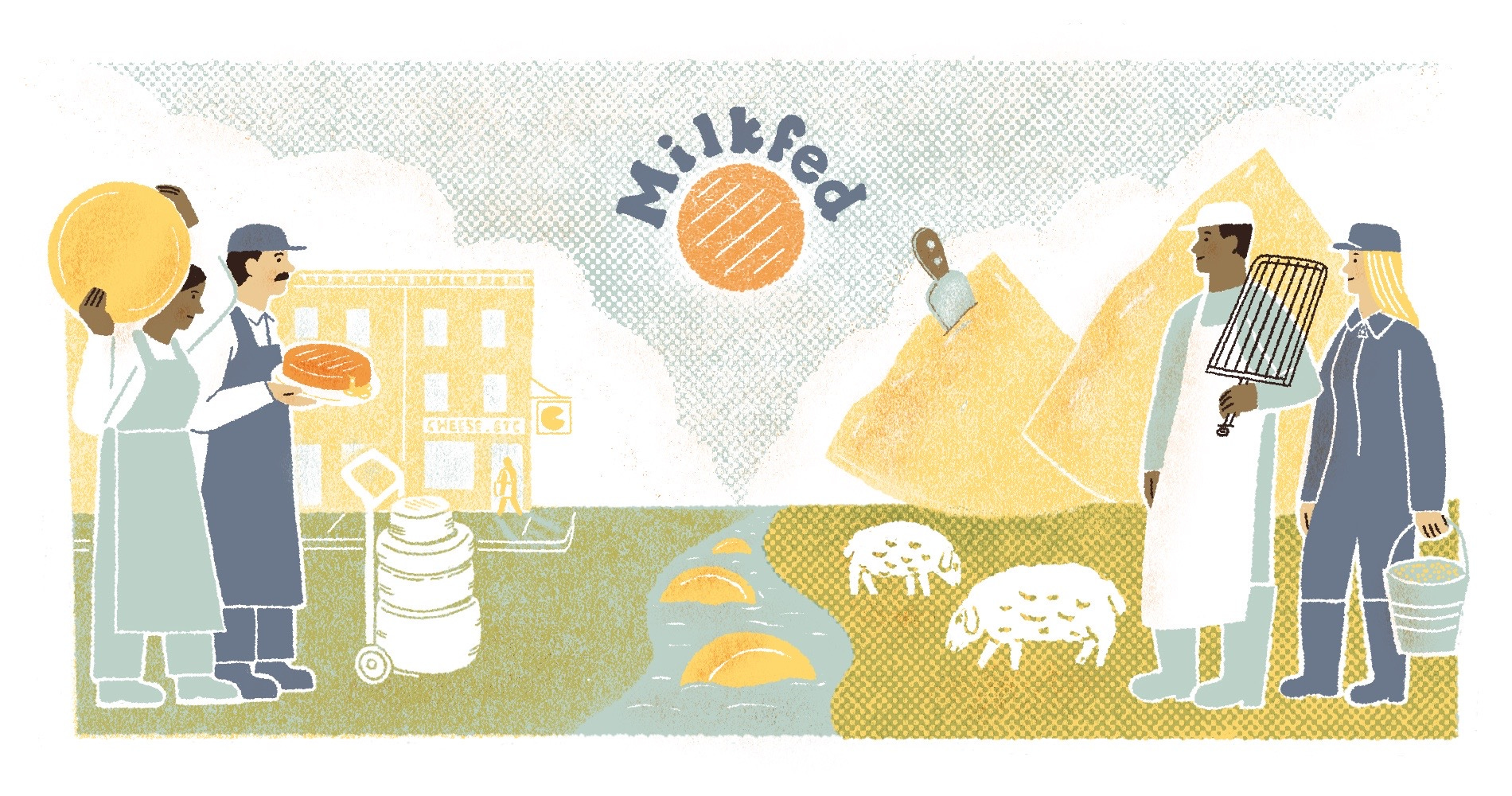
As promised, the first episode of my six-part limited audio series on cheese and climate change dropped today. We’re starting off with a short and sweet intro to who I am (for those who don’t know), the story and motivation behind this project, and a preview of what’s to come, with a little exorcising of my climate anxiety thrown in.
Links to listen below—along with the script for those of you who prefer a text-based experience.
Apple Podcasts:
Spotify:
Episode script:
Welcome to Milkfed, a podcast about cheese, culture, and climate. I’m Alexandra Jones, a cheese writer and educator based in Philadelphia. In this six-episode series, I’m using cheese as a lens to consider the relationship between our contemporary food system and the causes and effects of climate change.
Join me as I learn from farmers, cheesemakers, cheesemongers, historians, dairy scientists, and other experts. We’ll hear from the people who produce our food about how climate change is affecting their ability to feed us, and wrap our heads around ways we can both preserve the 9,000-year tradition of cheesemaking and survive in a rapidly changing climate.
Hi everyone! Welcome to Milkfed. This first episode is gonna set up the reporting you’ll hear in the next five episodes with a little intro, some context for this project, and how it came to be.
The first thing I want to get out of the way is: Who am I? You might know me from my food writing, my newsletter, or my work in cheese, but here’s a quick recap: I studied tuba performance in college, but it turned out I wasn’t actually all that good—plus, I was more interested in writing, anyway.
Right around the 2008 recession, I moved to Philly and started working at Trader Joe’s. I ended up as the order writer for the cheese section at my store, and I got really into holding tastings for the staff and setting up demos for holiday cheeses and stuff like that. That led to jobs as a buyer at a couple of sustainable agriculture nonprofits in the city, where I built relationships with dozens of farmers and purveyors in Pennsylvania and New Jersey. When I got laid off in 2016, I became a freelance food writer and all-around cheese pro—working events, teaching classes, helping to run a local cheese subscription, and selling cheese at farmers’ markets.
By 2020 or so, I’d transitioned mostly into writing. That’s the year my book, Stuff Every Cheese Lover Should Know, came out. At this point, cheese was basically the center of my professional universe. I worked for clients who promoted cheese or made cheese or sold cheese or things you served with cheese or that stored cheese.
But I felt this cognitive dissonance around the work I was doing and the realities of the climate crisis. The topic seemed under-discussed by the mongers, makers, and dairy farmers I knew. Not just the idea that we had an urgent responsibility to reduce the environmental impact of making and selling cheese, but how—and whether—we could continue in a rapidly changing climate.
I love cheese and the people who make it and age it. I salute the people who move it along the supply chain, and I derive so much joy from teaching eaters about it or connecting them with unique cheeses that make their eyes light up. But like so many of the things we do and use and consume in the Anthropocene, cheese—or, specifically, the scale at which it’s made and some of the methods used to produce it—has a not insignificant carbon footprint. And talking about that reality—even from a place of love, even from within the industry itself—can be difficult.
In 2023, I applied for a small grant from the Daphne Zepos Teaching Endowment with a proposal to research and write about the relationships between cheese and climate change. The DZTE is an incredible organization that funds two grants each year for food professionals to travel, learn about cheese-related topics, and share those findings with the industry at large. I proposed to focus on three questions: How do cheese and dairy production contribute to climate change? How are cheesemakers, dairy farmers, their animals, and their products being affected by our changing climate? And what are they doing to mitigate their impact, adapt to climate change, and build resilience?
I felt confident in my application, but I honestly wasn’t sure it would be taken seriously. I was gratified, surprised, and honestly a little terrified when I found out I won the grant —because although I was excited to dig into the research, I knew it would mean having some delicate conversations.
Climate change can be hard to talk about. It makes us feel vulnerable because we are vulnerable—both to the impacts of climate change and to the social stigma we sometimes experience when we speak frankly about this reality. So I’m going to share the origins of my own climate consciousness—the other half of the story behind this project besides cheese.
Do you remember the first time you really felt climate change? I don’t mean the first time you heard the term, or the first time you slogged through a Northeast winter without seeing a single flake of snow, or the years you had to time your showers to save water, or, god forbid, something more dangerous. I mean the first time you understood the gravity of the situation we’re in. The realization that humanity had charted this course long ago and ignored the warning signs alarm bells. And that all the recycling and composting and farmers’ markets in the world weren’t going to fix it, and the wheels were really starting to come off.
Maybe that’s just me. I was a ’90s kid who was raised on PSAs about recycling and acid rain and what was then called “global warming.” I grew up in California during one of the historic droughts that seem to get more historic with each passing year, and letting it mellow and limiting yourself to 5-minute showers were just…normal to me. By the time I was in middle school, I lived in North Carolina, where a tree fell on my family’s house during Hurricane Fran in 1996 (luckily, it missed my and my sister’s bedrooms by a few feet and only took out the shed). But it seemed that everyone there had a story about hurricane seasons past—they were a fact of life. The media and the general public weren’t making the obvious connections between these kinds of crises and disasters back then.
Even once I was an adult, working in what was, theoretically, the sustainable food movement, it didn’t really hit me. This was the era of The Omnivore’s Dilemma, and farm-to-table and food hubs and farmers’ markets and CSAs were all the rage. Somehow, I was sure, we were saving the world by buying pallets of tomatoes and apples direct from farmers and stocking beef from heritage breed cattle and selling raw milk, back when that felt like a relatively politically neutral thing to do.
No, it wasn’t until 2017 that I really understood that the trajectory of human history—of Earth’s history—was already skewed towards an uninhabitable planet. I still remember the moment it happened, and the twinge of panic that set in at the back of my neck. I was sitting at my desk at my part-time job for a local magazine—by now, I had pivoted mostly to writing about food rather than buying and selling it. I was supposed to be cranking out content, but instead, I clicked on a New York Magazine article titled “The Uninhabitable Earth.” It was by climate journalist David Wallace-Wells and begins with this sentence: “It is, I promise, worse than you think.”
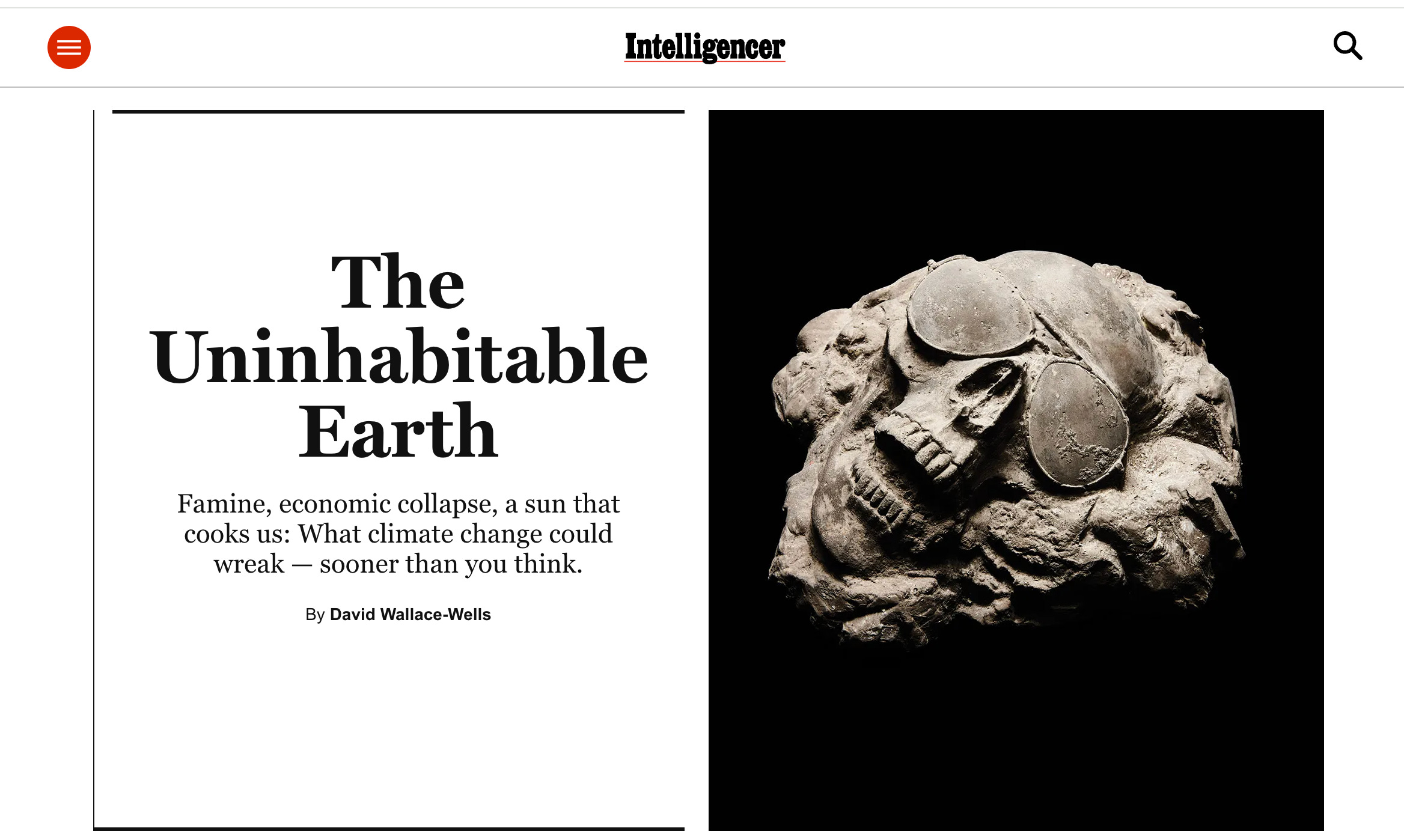
It grabbed my attention, and a lot of other people’s attention, too. The article is apparently the most-read in the magazine’s history. The gist was that the earth was—is—on track to become uninhabitable by humans in many regions much sooner than scientists once thought—or that just about anyone was willing to talk about or believe. Once I read this piece, those words lodged in my brain. It is, I promise, worse than you think.
I can understand this now looking back, but at the time, I didn’t yet know that that was the point that my future, my life, any chance of self-actualization or as-yet-unrealized dreams coming true or the general sense that things would probably end up pretty OK, began to fall away. It was a privilege I didn’t appreciate while I had it. I cried about it to my therapist, who did not understand why I was literally taking on the world’s problems as my own. I’ll put it this way: there was a moment in the very early days of the Covid-19 pandemic when I had the thought: At least I can be anxious about this instead of climate change for a while. Yeah. My brain is not the most fun place to be sometimes.
To be clear, simmering in a constant state of fear and hypervigilance is not a helpful way to cope with climate change—for me or for anyone else. Honestly, I don’t blame you for not fixating on the defining existential crisis of the anthropocene 24/7…or at all. As someone who has spent much of the past decade or so thinking about climate change pretty much all the time—first involuntarily, and now I guess voluntarily?—I honestly can’t recommend it!
But the way my climate anxiety manifests as an obsession with all the scary things that could happen—or are happening—and their inevitability. The feeling that it is too late, that I’m part of the culture that brought this on the world, that people could have done something about it but they didn’t and now we’re being punished for ruining the Earth, as we deserve.
The thing is? None of that is true. Yes, we are experiencing the consequences of climate change, and yes, we knew they were a likely possibility and could have done something about it and chose not to. And still have a responsibility to do everything we can to stave off the worst impacts, to protect ourselves and our communities and places and traditions and living things we hold dear.
I felt like the world had ended at that moment in 2017—and so much that’s happened in the past eight years has made me feel the same way—but somehow, the sun has risen each day. The world continues, in some form, until it doesn’t. And until that day comes, we have a responsibility to do what we can to make things better.
I’m still an anxious doomer sometimes, but working on this project has helped me feel some of these feelings, process them, and move through them to engaging with this situation and figuring out how to act. Something I hope to do for myself with this work—my research, my newsletter, and now this podcast—is channel that undiagnosed anxiety disorder energy into something that feels positive—if not for the world, then at least for myself, and maybe for a few other people listening too.
I conducted most of my research from summer 2023 to summer 2024. There were some delicate conversations, but some exciting and hopeful ones, too—with dairy farmers around North America operating at different scales, a climate researcher, a legal scholar, a dairy scientist and cheese historian, cheesemakers, cheesemongers. I got some answers to those three questions.
But climate change is still a challenging topic in agriculture, and when I presented my work at the American Cheese Society conference in Buffalo in 2024, what I had to say didn’t always land well (and, to be honest, I could have phrased some things better, too). When a room full of farmers and cheesemakers heard me say the word “degrowth,” things got a little tense. So when I decided to create an audio version of my project, with a little added commentary, backstory, and more of the voices I spoke to during my research—I knew there was room for refinement.
But in the year between then and when I’m recording this in 2025, something else happened.
The climate crisis became undeniable on a national scale—something I’d argue it’s been for years. But suddenly, it seemed climate disaster was everywhere. The weekend of that conference in 2024, parts of Vermont experienced their second 100-year flood in 2 years. A few months later, Hurricane Helene ravaged parts of the Southeast, including unprecedented flooding the likes of which Western North Carolina hadn’t seen in over a century. Hurricane Milton followed just a few weeks later, tearing across Mexico, the Caribbean, and Florida to wreak 50 billion dollars in damage.
And in January 2025, the Palisades Fire and the Eaton Fire destroyed nearly 20,000 structures, including the home in Altadena my father and grandmother grew up in, and much of the surrounding town. (You can read my essay about this in my newsletter, linked in the show notes.) Mitigation was—is—still essential for a livable future. But focusing primarily on ways to reduce emissions began to feel out of touch. The threat is here, and we needed to adapt and build resilience to make it through whatever was next. I wanted to bring in more of that messaging to this work.
And then things went from not great to really not great. Almost immediately afterward, the current presidential administration began to dismantle climate initiatives and research, along with just about everything else the federal government is good for. Climate action has never been the government-led, New Deal-style coming together to defeat a common threat that it could have been in a just world. But the administration was ripping away what supports had been made available to folks like dairy farmers. Adaptation was no longer about applying for a USDA grant or enrolling in a federal conservation program. It was going to have to be something we’d have to do ourselves, if we did it at all.
So things have changed since I first presented my research, but I didn’t want to let those stories sit unheard on my hard drive. Over the next five episodes, you’ll hear from many of the folks I interviewed. I’ll take you back through 9,000 years of cheese history to understand how we arrived at this point—where a food that once protected humanity from extinction could be implicated in the Anthropocene for playing a role in making our planet unlivable. And we’ll learn how the people who make, move, and sell your cheese are mitigating, adapting, and preparing for what’s to come.
Whether you’re a cheese lover, a climate nerd, an avid learner, or one of the hardworking people who makes cheese happen from pasture to plate, I hope you’ll join me. And if you’re into this, you can find me on what one fan called “my political cheese newsletter,” Milkfed: Notes on Cheese, Culture, and Climate at milkfed.substack.com. There, I’m sharing behind-the-scenes content from my research and additional commentary that didn’t make it into these episodes. Thanks for listening, thanks for caring, and I’ll see you next time.
Milkfed: Notes on Cheese, Culture, and Climate is researched, written, and hosted by me, Alexandra Jones. It’s edited by Abby Cerquitella. I’m grateful for the support of the Daphne Zepos Teaching Endowment, which made my research and this podcast possible. You can learn more and donate to this amazing cheese education nonprofit at dzte.org. If you’d like to support the show, please subscribe, leave a five-star review, or tell a friend about us.
Great intro, Alex. I’m all ears for the next episode!
Really looking forward to this series!