
Slick Cows, Microbe Management, and PDOs in Peril
The possibilities and limits of climate adaptation.

It’s the adaptation episode, folks! To protect their animals and their businesses, dairy farmers and cheesemakers have to adapt to a changing climate. I bring you the stories of a dairy farmer in Puerto Rico who's breeding heat-resistant cows, a goat farmer and cheesemaker in Vermont dealing with microbial unpredictability in her geothermal cheese cave, and a shepherdess in the mountains above Los Angeles whose farm and life changed drastically after a wildfire tore through her land.
We’ll also dig into the climate risk factors that are making dairy farming more difficult even in cooler climates, like New England and the Swiss Alps, and consider what farmers and food producers can do to adapt their businesses in our current state of climate denial and economic austerity.
Listen or read the full script below! (No Spotify player today because there’s a glitch with embedding, hopefully it’s fixed soon.)
Apple Podcasts:
Episode script:
Welcome to Milkfed, a podcast about cheese, culture, and climate. I’m Alexandra Jones, a cheese writer and educator based in Philadelphia. In this six-episode series, I’m using cheese as a lens to consider the relationship between our contemporary food system and the causes and effects of climate change.
Join me as I learn from farmers, cheesemakers, cheesemongers, historians, dairy scientists, and other experts. We’ll hear from the people who produce our food about how climate change is affecting their ability to feed us, and wrap our heads around ways we can both preserve the 9,000-year tradition of cheesemaking and survive in a rapidly changing climate.
Hi everyone! This is episode 5 of Milkfed, and the penultimate installment of this limited series. Last time, we learned about the sources of carbon emissions globally and zeroed in on how the ways we use land and the foods we produce contribute to up to a third of greenhouse gases.
We also talked about climate solutions—and why I’m not always a fan of the narratives that often surround them—and dug deep into two very different ways of mitigating the methane from livestock waste: anaerobic digesters and biochar. And I mused about the ways folks who work in cheese might be able to introduce a little flexibility into the ways they make and market their products, and how we can shift our diets to reflect climate reality without giving up our devotion to thoughtfully produced animal foods completely.
In today’s episode, we’re going to talk about another strategy for responding to climate change: adaptation, or switching up the way we do things in response to the conditions we’re currently experiencing and working to prepare ourselves for future climate-related challenges.
We’ll cover how climate change is making our weather more volatile all over the world—and making farming and food production more difficult—and the ways growers can adapt in response. We’ll hear about some producers and their climate adaptation efforts—and also about the limits of adaptation as a strategy. And I’ll tee up our final installment, which will cover what a climate-resilient American cheese industry might look like.
No matter where you live—city or country, east or west, northern or southern hemisphere—you’ve experienced the effects of climate change. Some of these changes may have been so gradual that you didn’t notice for years—did it always get this hot, or rain this much, for this long, in July? Did winters always swing from snowless one year to positively arctic the next?
Since the 19th century, when we began burning fossil fuels to power the Industrial Revolution, emissions-generating human activity, including agriculture, has been the driver of incredibly rapid global warming. More atmospheric carbon has caused global average temperatures to trend upwards, but as anyone who’s shivered their way through a polar vortex knows, climate change doesn’t just mean higher overall temperatures.
It’s also meant atmospheric rivers—vast areas of precipitation that hover over a region for days, causing sustained periods of heavy rain that can lead to disastrous flooding, destruction of homes and businesses, and loss of life. It’s meant a longer Atlantic hurricane season with more and more intense storms that have caused billions of dollars of damage—not just in wind-battered Florida, but as far north and west as Appalachia. Extreme heat and drought conditions contribute to wildfires—not only in places like the West Coast, but in my neighboring state of New Jersey during hot, dry summers in the Pine Barrens.
And that’s just in the United States. Climate change has contributed to water shortages in the Italian province of Emilia-Romagna, threatening the farmers whose milk is made into Parmigiano-Reggiano. In Switzerland, it’s resulted in retreating Alpine glaciers, which have made routes used for centuries by herds of livestock and their shepherds in the ancient ritual of transhumance too unstable to travel, and water shortages endangering the treasured Alpage cheeses that carry forth the flavors of the herbs and wildflowers growing in those high mountain pastures.
Farmers have never been able to control the weather, but climate chaos has subjected food producers to new levels of chaos: extreme temperatures, too much (or not enough) rain, unseasonable heat and cold, and less predictable conditions overall increase the likelihood of crop failures, reduced or damaged harvests, and lost revenue. They can also endanger animal health and create unsafe conditions for farm workers.
We call these factors climate risk—and increased climate risk is making the act of growing, harvesting, storing, and transporting food more difficult and less reliable. That’s bad for farmers, eaters, and everyone along the supply chain—and bad for our overall food security
Here’s an example of how dairy farms in the Northeast US are experiencing increased climate risk, courtesy of the USDA’s Northeast Climate Hub. The visual learners among you can visit the link in the show notes for this information in graphic form.
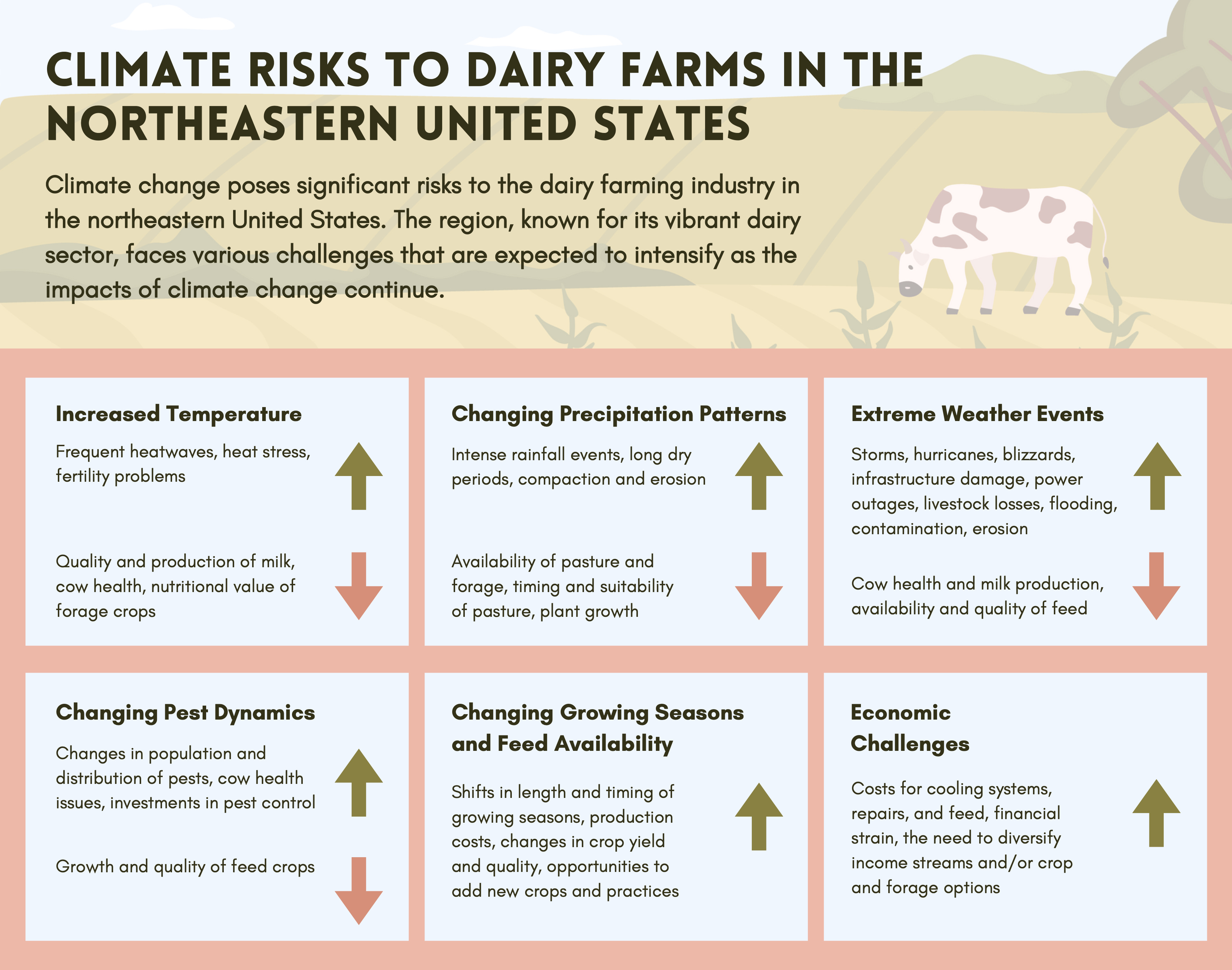
Increased temperatures endanger livestock, and heat stress can lead to fertility problems, milk quality and production issues, and reduce the nutritional value of forage crops grown to feed them. (Note that USDA makes no mention of extreme weather events increasing health and safety risks for the people who have to care for those animals, but it’s no surprise that the largely immigrant farm workforce in the US is often left out of the climate conversation.)
Changing precipitation patterns have made rainfall in the region much more intense, with longer dry periods in between, which can contribute to soil compaction and erosion. Wonky rainfall also affects plant growth, which can in turn affect the quality and availability of pasture and feed crops. And you can ask any business that relies on direct sales from farmers’ markets as a revenue stream how the heaviest rain, ice, and snow always seem to hit just in time for the weekend.
Pest dynamics are also changing as the climate warms and weirds in the Northeast. Larger populations—or newly problematic species—of insect pests can contribute to animal health issues and damage feed crops, forcing farmers to invest in pest control strategies or suffer the consequences.
And of course, more frequent and intense extreme weather—heat domes, droughts, tornadoes, hurricanes, wildfires, ice storms, hundred-year floods that are becoming every-year floods—aren’t good for anyone.
Between 1980 and 2024, the U.S. experienced 403 weather and climate disasters in which the overall cost of damage was at or over $1 billion dollars, with a total cost of nearly 3 trillion dollars and more than 3100 deaths, according to a National Centers for Environmental Information report from 2024. A fun pink banner at the top of the official US government webpage for this report says that it will no longer be updated, quote, “in alignment with evolving priorities, statutory mandates, and staffing changes.” Very cool. Awesome.
It’s worth noting that the factors that increase climate risk in some areas can result in changes that may benefit producers in some ways. Remember Sam Dixon, pasture manager at Shelburne Farms in Vermont, who we heard from in the last episode? As spring has begun to arrive earlier, he’s found that pastures are ready for the herd to chomp their first tender blades of spring grass 2 to 3 weeks earlier in the season than they used to some years.
Where I live, the Philadelphia Orchard Project—an incredible urban ag organization that I’m proud to volunteer for—is trialing subtropical trees like loquats, olives, kumquats, and even hardy banana varieties in high tunnel greenhouses. These benefits make a great climate solution story—or maybe a better way to put it is a climate silver lining—but the rapid and chaotic nature of these climatic shifts we’re experiencing means that any potential benefit is far outweighed by the greater likelihood of extreme conditions.
As climate risk increases, it becomes more challenging and more expensive for farmers of all kinds to grow, harvest, and distribute our food—not just in the US, but globally. This in turn drives up everyone’s grocery costs. In recent years, climate change has contributed to unprecedented price spikes in produce grown in California and Korea, olive oil from Spain and Italy, rice in Japan, and cacao in Ghana and the Ivory Coast, where 60 percent of production is located.
Farmers face higher costs elsewhere, too—not just the cost of recovery or repairs for climate-related damage or losses, but of adaptation and resilience measures, too. Those higher costs get passed along the supply chain to consumers. For many small- and midsized farmers and food businesses, there’s barely any margin left to absorb these costs—which, piled on top of inflation, tariffs, higher healthcare and utility costs, and loss of funding support from federal programs (at least in the US), means those businesses are at a higher risk of going bust.
The effects of climate change aren’t limited to farm businesses or rural landscapes, either. Floods and blizzards can endanger lives, damage buildings and infrastructure, and make roads impassible anywhere—keeping product from arriving at its destination, employees from getting to work, and customers from getting to retailers. Storms and heatwaves knock out power and strain electrical grids—which is never something anyone in the perishables business wants to think about.
Increased climate risk also makes insurance for homes, farms, and businesses more expensive and more difficult to obtain. If you own a home and you’ve noticed your insurance spiking crazily in recent years, it’s because of climate volatility in places like Florida, Texas, and Southern California, where wildfires, heat, storms, and other climate-related extremes have caused insurers to simply stop insuring homes in those places. Don’t live anywhere near those areas? Too bad, because those insurance companies need to make up for those lost premiums somewhere, and it’s coming out of your pocket.
All of these things can make it more difficult for businesses along cheese and dairy supply chains to produce and distribute their products. (They also increase the overall cost of living for everyone, meaning it’s hard for consumers to pay a premium for local, artisan, or sustainably raised products.) It’s worth noting that pandemics like Covid-19 and bird flu are linked to increased climate risk, too.
Of course, it is possible to adapt—to make changes in how we grow, process, move, and store food in response to higher climate risk—if our material conditions allow, though that’s a big IF. Some of these adaptations are pretty amazing and can even do double-duty as mitigations. But as we’ll learn from some of the producers I talked to during my research, you can’t simply adapt your way out of the worst impacts of climate change.
Ask any dairy farmer in the northern hemisphere and they’ll tell you that cows don’t do super well in hot weather. They don’t eat as much, their milk production drops, fertility rates drop, and their immune systems don’t work as well.
And it doesn’t even need to be that hot. Dairy cows can experience heat stress when the temperature is as low as 72 degrees Fahrenheit if the humidity is high enough. That unfortunate relationship between heat and humidity is known as wet bulb temperature—I’m oversimplifying this, but it’s basically the temperature at which the humidity is so high that your body can’t cool itself naturally. (For reference, human health is endangered at 87 degrees Fahrenheit and 100 percent humidity.)
As extreme heat and humidity increase throughout the world, dairy farmers and researchers are working on ways to keep their animals cool, from low-tech interventions like incorporating more trees into pasture or building structures to provide much-needed shade to installing wifi-enabled “smart barns” with features like automatic ventilation and temperature control—definitely a pricier, tech-ier, and more energy-intensive approach to this challenge.
One reason that most of the cows in North America are struggling with heat as the climate warms is that they’re Holsteins, originally a Dutch breed whose genetics have been refined over generations to be great at hanging out in a barn and pumping out huge quantities of milk, not keeping their cool in ever-intensifying heatwaves.
Farmers can help their herds cope with extreme heat by incorporating genetics from cows who can. As we learned in Episode 2, there have been cows in some of the hottest parts of the world for thousands of years; the zebu, or Bos indicus, one of the two main species of cow, was domesticated on the Indian subcontinent 6 or 7 thousand years ago. In fact, the zebu’s signature differences from the European cattle we’re used to—its hump, its long, floppy ears, and loose, rippling neck folds known as a dewlap—help it withstand harsh, hot conditions by storing extra energy in the form of fat and by helping to dissipate excess body heat.
Zebu have been raised in the US, Mexico, and Brazil since the early 20th century, but there are cows that have been hanging out in the tropics of the Western hemisphere for even longer. Criollo cattle are descended from cows first brought to the Americas by Spanish colonizers in the 15th and 16th centuries. Since then, they’ve developed natural mutations that help them thrive in hot climates throughout South and Central American and the Caribbean.
When you think of agriculture in Puerto Rico, maybe your mind goes to tropical fruits, which seem to grow everywhere there—in backyards and by roadsides and highways as well as on farms—or the sugar cane plantations established by the Spanish that began to dominate the landscape in the 16th century. Puerto Rico’s agricultural history and its present-day foodscape have been indelibly shaped by colonial rule, first by Spain for 4 centuries and since 1898 by the US, which claims it as a territory.
Due to strictures like the Jones Act, a protectionist policy that requires shipments to Puerto Rico to be carried on US-owned vessels, agricultural imports from the mainland have flooded markets in the territory, driving local farmers and producers out of business, which then enables mainland producers to raise prices in an effective monopoly. Combined with high freight rates that Puerto Rico is obligated to pay, the result is that 80 percent food there is imported—and expensive. Two decades into a severe economic crisis, 40 percent of the population is experiencing food insecurity. Those stats are from a 2021 New York Times op-ed by Alicia Kennedy and Israel Meléndez Ayala—you should pause this and go read the whole thing.
So how does dairy fit into the picture? Today, it’s 25% of Puerto Rico’s farming sector and the territory’s most significant agricultural product. And in fact, fluid milk is one commodity that’s not allowed to be imported, which means that dairy farmers don’t have to compete with imports (though value-added products are a different story). Many farmers there raise cows on pasture, and year-round sun means grass grows all year long, so in some ways, it seems like dairy farming there could be relatively easy to do without a ton of inputs, making milk more affordable for consumers. But Puerto Rico is small—bigger than Rhode Island but smaller than Connecticut—which means there isn’t enough land to pasture all those animals without supplemental feed. So many farmers still buy in expensive feed, which must come from the US, causing really high input costs. Even without competition from imports, consumers pay $7 a gallon or more.
This is the context in which Puerto Rico’s dairy farmers are trying to adapt to climate change—which is causing drought conditions to intensify in some areas while also increasing life-threatening heat and humidity. 2023’s record-breaking heat wave there included a handful of 120-degree days—remember that the more humid it is, the lower the temperature that can cause severe health issues or even death for people and animals. Unfortunately, most of the cows in Puerto Rico aren’t those well-adapted Criollos, but—you guessed it—Holsteins, part of a midcentury effort to industrialize and modernize the archipelago’s dairy industry.
Many of Puerto Rico’s farmers went all in on high-producing, state-of-the-art Holsteins imported from the mainland, leaving their hardy but lower-producing Criollos behind. But not Rafi López-López, a third-generation dairy farmer raising cows in Hatillo, located on the main island’s north coast and the epicenter of Puerto Rico’s dairy industry. At Vaqueria El Remanso, Rafi has been raising vacas pelonas—known in English as “slick” cows—that are better able to withstand the hot-and-getting-hotter climate in places like Puerto Rico. These shiny-coated animals combine the heat-resistance of Criollos with the high production of Holsteins. Rafi has been breeding these genetics into his herd since the 1990s, and he now has more than 150 cows with these thermoresistant traits.
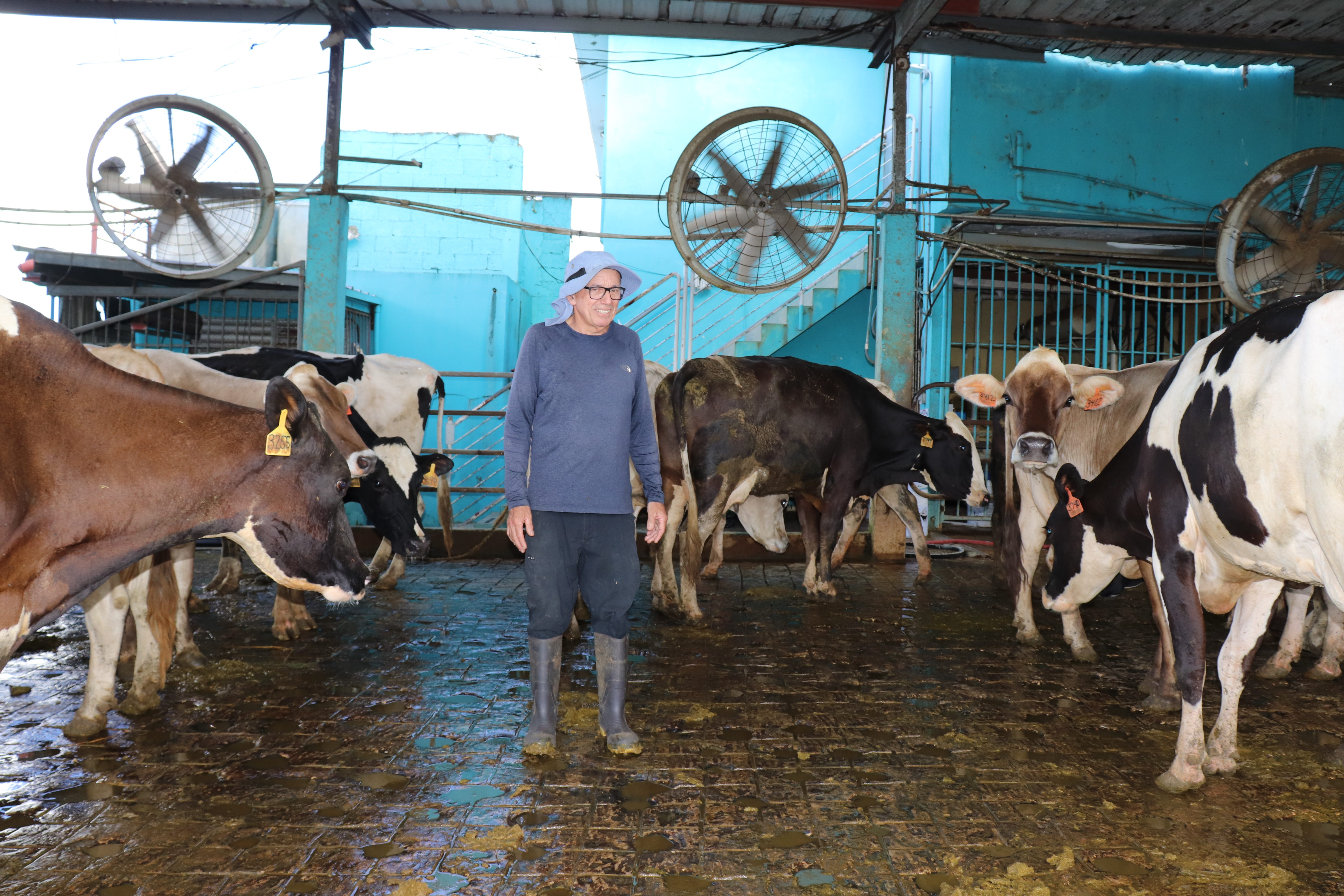
Thanks to my Daphne Zepos Research Award funding and a former Philly media colleague now based in Luquillo, Katherine Rapin, who had reached out to me as she was reporting a story on Rafi, I got to go on a whirlwind tour of Puerto Rico’s dairy industry—including a visit to Rafi’s farm. Please read her excellent piece, which was published in Offrange, about the work not only Rafi but scientists and researchers there are doing around slick cows.
Slick cows get their thermoresistance in part from their thinner coat, which gives them a shiny, slick look; they won’t have the fuzzy tuft of hair on their head that non-slick cows do. (Hit up the show notes for some cute cow pics I took that illustrate this difference.) The benefits of naturally cooler cows are reflected in some really key metrics: Rafi says he gets 1800 pounds more milk per lactation from his slick cows than from his non-slick cows, and that breeding is more effective. In studies, calving intervals with slick cows—basically the time it takes for a cow to get pregnant—have been shown to be shorter by a month and a half.
All of that is good news for a tropical dairy farmer—so good, in fact, that Rafi’s bull Sinba was the first-ever homozygous slick bull whose semen was made commercially available. (Homozygous here means that his offspring are guaranteed to have slick traits.) Sinba was sold to a breeding company which is now making those slick genetics available in the US, Southeast Asia, South and Central America, and Qatar.
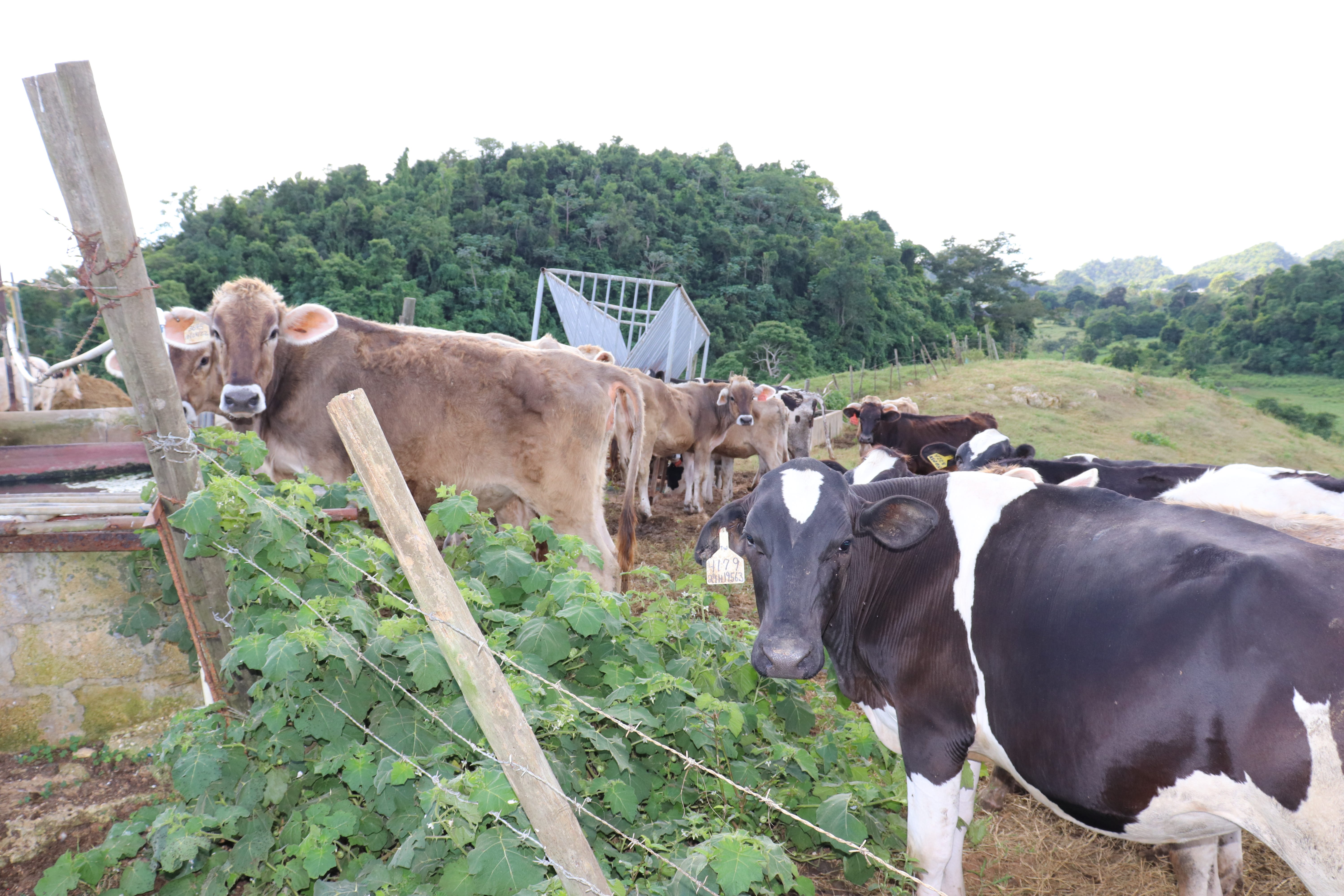
Ironically, many farmers in Puerto Rico don’t have access to those slick genetics, even though they originated on the island, because buying them back from big US breeding companies is too expensive. Katherine and I visited a research facility where the University of Puerto Rico in Mayaguez is working with other slick bulls on a project to make those genetics more accessible locally.
In addition to breeding in heat-resistant genetics, there are other ways that local and USDA researchers recommend dairy farmers in Puerto Rico and other tropical regions adapt their farms to increasing heat, humidity, drought conditions, and other intensifying climate risks. Incorporating more trees into pasture or building structures to provide much-needed shade, growing higher-quality, drought-resistant feed crops, improving soil quality to better hold moisture, collecting and conserving water, managing landscapes to reduce the risk of wildfires and flood damage, and organizing networks of producers to share best practices and maintain communication in the event of climate disasters. Those honestly sound like pretty great ideas for just about any dairy farm to apply to in response to climate change.
Puerto Rico’s dairy industry may be on the front lines of climate adaptation, but farmers are switching up their operations elsewhere, too. When I visited Comte producers in France’s Jura Massif in 2024, one farmer told me he’s changed up the crops he grows in response to longer dry spells in the region; the field across from his milking parlor was planted with sorghum—a crop his father had never grown—because it was better able to thrive in those new conditions.
The changing climate is affecting artisan cheese, too. One importer of Comte told me that they’d seen a shift in which wheels they selected from their affineur. Fall and winter batches were more likely to be chosen for sale, because their quality is so much more consistent in those months than in the summer, which used to be a more desirable time of year. In fact, extreme heat and drought in France in 2022 and 2023 has caused some producers’ associations to reconsider the strict parameters of their PDOs—the regulations that dictate the location, breed, type of feed, and other specs about how a traditional cheese is produced.
And it’s not just cow creameries who are seeing changes in climate come through in their finished product: Laini Fondillier of Lazy Lady Farm—who recently announced her well-deserved retirement after nearly a half-century of making cheese on an off-grid farm in Vermont’s Northeast Kingdom—told me about the increasing difficulty of keeping her French-inspired goat cheeses consistent in her underground, naturally cooled cheese cave. In recent years, hotter, more humid summers meant wheels would ripen too quickly, and their snowy, wrinkled rinds developed harmless defects like stray spots of blue mold or fuzzy gray mucor more often.
This made selling her cheese an increasingly challenging proposition, as both buyers and consumers have been conditioned to see even cosmetic variations in cheese as defects that merit a refund. According to Paul Kindstedt, who we heard from in episode 2, climatic shifts can affect not only the comfort and performance of dairy animals, but the quality of their feed, which translates to greater variability in the fat, protein, and moisture content in their milk. For artisan producers who don’t standardize fat and protein levels, this makes achieving a consistent product more challenging.
A really unfortunate aspect of how quickly climate change has intensified is that those extreme conditions have made production methods with a smaller environmental footprint, like Lazy Lady’s geothermal cheese cave, tougher to implement. One of the most heartbreaking examples of this from my research is the story of Angeles Crest Creamery, which began in a historic house in my grandmother’s neighborhood of Altadena, California in the foothills northeast of Los Angeles. Farmer Gloria Putnam started out with a small backyard herd, making and selling cheese and other value-added products to friends and neighbors and teaching cheesemaking classes in her home.
Gloria’s plans changed when she realized that people thought her operation was super sustainable because she was raising animals and producing food. But in reality, she was buying in hay that was grown in this water-stressed part of the country and trucked into the city to feed her goats. She had a vision that they could move to the mountains and model climate-resilient, water-neutral agriculture in the kind of high desert climate that goats can be well adapted to, and that’s exactly what she did in 2014.
At its peak, Angeles Crest Creamery had about 250 goats, and Gloria was still making small batches of value-added products as well as selling animals for meat. Her goats would browse native plants on the 70-acre property, eventually getting to the point where she was only feeding some supplemental hay in winter, along with a little grain for the small milking herd.
But the farm—and Gloria’s vision for it—changed drastically in 2020, when the Bobcat Fire, which burned more than 100,000 acres in and around Angeles National Forest over two and a half months, tore through the property. Gloria and her partner and their goats were able to evacuate, and while most of the structures were OK, much of the goats’ foraging land was burned.
The fire completely altered Gloria’s plan to feed her goats off the land. Post-fire landscapes are extremely delicate, especially when we’re talking about these slow-growing, high-desert species that grew on the property, and it wouldn’t be able to support anywhere near 250 animals in this condition any time soon.
Since then, Gloria has scaled the operation way down, keeping only a small number of goats, no longer as milkers, and feeding them with supplemental hay. The fire has drastically altered her mission as a citizen scientist and sustainability educator. In the 6 years since the fire, she’s been chronicling the regrowth of the burn scar on and around her property and replanting native species. Lots of plants have started growing back, but larger shrubs haven’t returned, and it’ll be hundreds of years for trees like pinyon pines and Joshua trees to return and mature.
In my conversation with Gloria in 2024, she brought up the idea of migration. We often think of seasonal, annual migration, like Alpine transhumance, but in the context of fire-affected ecosystems like prairies, chaparral, and pine forests, that migration might mean not returning to an area for many years, until the land had regenerated and can support you and your animals again. The way we raise animals in the US isn’t set up for nomadic shepherding, but for millennia, and in many parts of the world today, livestock farming involves that kind of cyclical movement over common lands. What changes would have to take place for that kind of dairying to be more viable—or even essential—in the US?
So…what now? In ideal conditions, we’d not only be mobilizing to drastically lower carbon emissions on a global scale, but also equip communities with the tools they need to adapt to our new not-normal—everything from heat pumps to increase energy efficiency in buildings to creating green spaces to reduce the urban heat island effect in cities to growing more resilient crop varieties and building sustainable, affordable housing in farm country. Unfortunately, right now in the US, for dairy farmers and for everyone else, our adaptation strategy is similar to our mitigation strategy: it’s everyone for themselves, if they have the resources and the will to make it happen—which means a lot of people, businesses, and communities aren’t getting what they need in this crucial moment.
I also don’t think we should take the prepper approach, thinking solely on individual terms, because these are collective rather than individual problems—although I think everyone, whether you live on a farm or in a studio apartment, should have a go bag, a stash of emergency food and supplies, and a practical plan for how you’ll respond to the climate disasters most likely in your area. (I’m by no means an expert on emergency preparedness, but I am someone who did my massive pre-pandemic grocery shop a full week before the announcements stay-at-home orders had people scrambling for scraps on supermarket shelves, so my anxiety brain has been right about this kind of thing at least once before.)
We’re going to focus on that communal, big-picture response in the final episode of this limited series: what dairying could look like in a climate-resilient food system—not just farms, but all along the supply chain. And we’ll hear from one cheese shop owner who has been forced to cope through one climate disaster after another—about what drives her to keep opening her doors, supporting makers, and serving her community every day.
I hope you’ll join me again in 2 weeks for this last installment of Milkfed the podcast! If you’d like to hear more episodes in the future, I’d love to know some of the cheese and climate-related topics you’d like me to tackle. Thanks as always for listening, and I’ll see you next time.
Milkfed: Notes on Cheese, Culture, and Climate is researched, written, and hosted by me, Alexandra Jones. It’s edited by Abby Cerquitella. I’m grateful for the support of the Daphne Zepos Teaching Endowment, which made my research and this podcast possible. You can learn more and donate to this amazing cheese education nonprofit at dzte.org. You can learn more about me at my website, alexandrajones.net, and subscribe to my newsletter—also covering cheese, culture, and climate—at milkfed.news. Thanks again for listening.
Another great episode, Alex! Thank you for this work!